By the Klick Digital team · Updated October 2026
Chinese travellers are one of Thailand’s largest visitor groups, but most of them will never search for your restaurant, bar, spa or shop on Google or Facebook. They plan, compare and navigate inside Chinese apps. If your venue is not visible there, it does not exist for this customer.
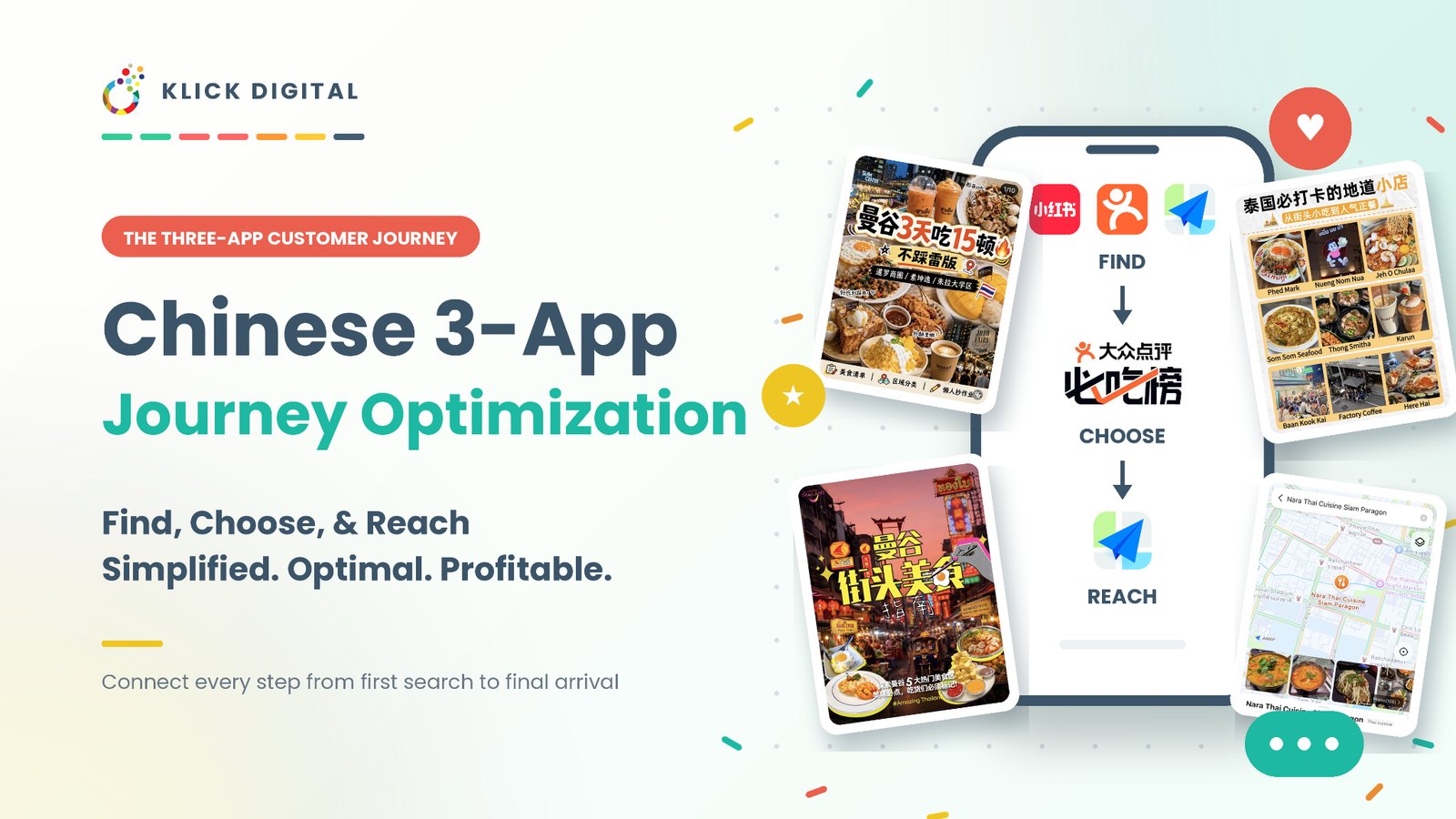
The journey has three steps and three apps: they find ideas on Xiaohongshu (RedNote), they choose a venue on Dianping/Meituan, and they reach the door with AMap. This article explains each step, what a Thai venue must have in place on each app, and where venues usually go wrong.
How Do Chinese Tourists Choose Restaurants in Thailand?
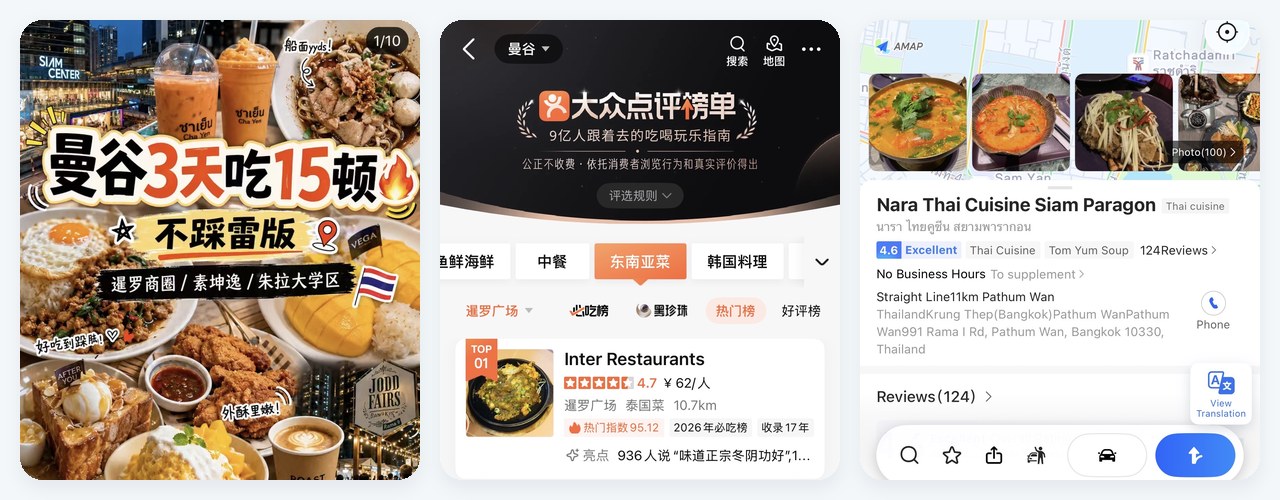
In short: they get inspiration from posts on Xiaohongshu, check reviews and ratings on Dianping/Meituan, then open AMap for directions or a taxi. The decision is often made before they land, and almost always made inside these apps rather than on a search engine.
This is different from how Western or Thai customers behave, and it is the reason a venue can be full of Thai and European guests while Chinese travellers walk past to a competitor two doors down.
Step 1 – Find: Xiaohongshu (RedNote)
Xiaohongshu, known internationally as RedNote, is where the trip starts. Travellers search in Chinese for things like “曼谷必吃榜”, “普吉岛屋顶酒吧” or “清迈按摩” and save posts from other users and creators. It works like a mix of Instagram and a travel guide, and content there is trusted because it looks like a friend’s recommendation.
What your venue needs on Xiaohongshu:
- A verified brand account under your Chinese name, with posts tagged to your location
- Real posts and videos from creators (KOL/KOC) and guests, not only your own adverts
- Content that answers the questions travellers actually type: what to order, how much, how to get there
- A steady rhythm of new posts, because older content drops out of search
Step 2 – Choose: Dianping/Meituan
Once a traveller has a shortlist, they open Dianping (part of Meituan) to decide. Dianping has hundreds of millions of users in China and is the app people use every day at home to pick a restaurant. Abroad, they use it the same way: compare ratings, read reviews in Chinese, look at photos of the menu and check whether a venue is on the Must-Eat list (必吃榜) or offering a deal.
What your venue needs on Dianping/Meituan:
- A claimed and verified POI (listing) with correct Chinese name, category, address, hours and phone number
- A decorated homepage with good photos, a Chinese menu and highlight dishes or services
- Reviews in Chinese, and replies to them; a venue with no reviews is skipped
- Ad credits and media optimisation so the listing appears when people search your area
- Monthly reporting so you can see what is working
Klick Digital works directly with Dianping/Meituan to set up, verify and manage listings.
Step 3 – Reach: AMap
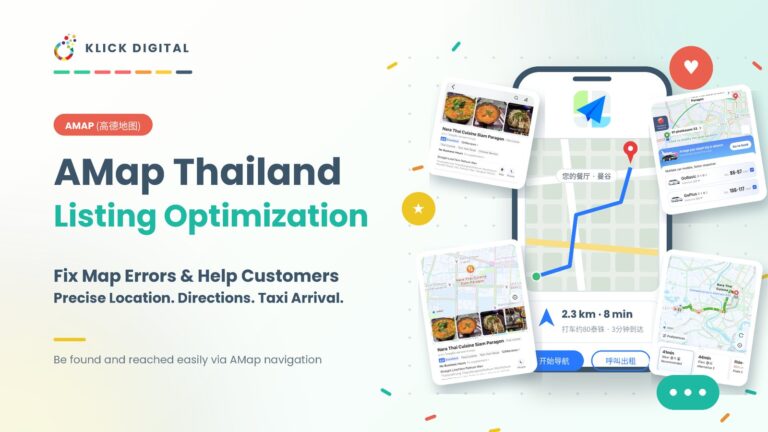
A traveller who has chosen your venue now needs to get there. Chinese travellers use AMap (高德地图) rather than Google Maps, because it works in Chinese, shows Chinese place names and lets them call a taxi to the venue’s door from inside the app. If your pin is missing, in the wrong place or under a Thai-only name, the guest you almost won takes a wrong turn and ends up at a competitor.
What your venue needs on AMap:
- A listing with your Chinese and English name, so both the traveller and the driver can find it
- A pin placed at the actual entrance, not the middle of the block or the back of the mall
- Correct opening hours and phone number
- Photos of the entrance so the guest recognises it from the taxi
What Does the Journey Look Like for a Typical Traveller?
Imagine a traveller from Shanghai, Li Wei. Two weeks before her Bangkok trip, she searches “曼谷 泰餐 必吃” on Xiaohongshu and saves three restaurants that creators have posted about. On the plane she opens Dianping and compares the three: one has a high rating, plenty of recent Chinese reviews and a set-menu deal; one has a good rating but no new reviews for months; one is not on Dianping at all. She picks the first.
On the night, she opens the restaurant’s page on AMap, taps “call a taxi”, and the driver takes her straight to the door. She orders the dishes she saw in the posts, photographs them, and leaves a review on Dianping the next morning. The cycle starts again for the next traveller.
The restaurant that was not on Dianping never had a chance, even if its food is better.
What Are the Most Common Mistakes Thai Venues Make?
The most common mistake is treating Chinese travellers like every other customer and relying on Google and Facebook. The others are small on their own but each one breaks the journey:
- Only on Google and Facebook. The traveller never searches there, so your marketing is invisible to them.
- No Chinese name. Without a consistent Chinese name across all three apps, travellers cannot search for you, and drivers cannot find you.
- No reviews, or old reviews. A Dianping listing with no Chinese reviews looks closed or untrustworthy. Travellers move on.
- Wrong pin. A pin that is 200 metres off, or in the wrong building, is the difference between a full table and an empty one.
- Content once, then silence. One Xiaohongshu campaign fades within weeks. Visibility needs a regular schedule.
- Listing left unmanaged. Menus change, hours change, phone numbers change. An unmanaged listing drifts out of date and gets ignored.
Checklist: Is Your Venue Ready for Chinese Travellers?
Use this list before the next high season.
Xiaohongshu (RedNote)
- ☐ Verified brand account
- ☐ Chinese name on the profile and location tagged on posts
- ☐ Creator (KOL/KOC) posts and videos in the last 90 days
- ☐ Content answers “what to order, how much, how to get there”
Dianping/Meituan
- ☐ Claimed and verified POI with correct Chinese name and category
- ☐ Homepage decorated with photos and Chinese menu
- ☐ Chinese reviews, with replies
- ☐ Ads and media optimisation running
- ☐ Monthly report reviewed
AMap
- ☐ Listing with Chinese and English name
- ☐ Pin at the real entrance
- ☐ Hours and phone number correct
- ☐ Entrance photo uploaded
Across all three
- ☐ Same Chinese name everywhere
- ☐ Someone responsible for updates every month
How Does Klick Digital Help?
Klick Digital is a Bangkok-based agency that has worked in Thai, Chinese and English since 2016. We are the official Thailand partner for Dianping/Meituan and AMap, which means we set up, verify and manage your listings directly with the platforms. On Xiaohongshu we set up verified brand accounts and run content and ads, with direct support from Xiaohongshu HQ; our Xiaohongshu campaign with Big C won Best Use of Social Media at the PR Awards Asia-Pacific 2026.
For most venues, the right starting point is the Dianping package: POI information, media ads with ad credits, media optimisation, homepage decoration, review management and a monthly report, with full account management included. From there we add Xiaohongshu content and AMap so the whole journey works.
We work with restaurants and cafés, bars and rooftop bars, spas and massage, retail and souvenir stores, hotels, clinics and dental clinics.
Frequently Asked Questions
Do Chinese tourists use Google Maps in Thailand?
Rarely. Most use AMap because it works in Chinese, shows Chinese place names and lets them call a taxi from inside the app. Your venue needs a correct pin on AMap.
Which app matters most for a restaurant?
Dianping/Meituan is where the decision is made. Xiaohongshu brings awareness and AMap gets the guest to the door, but a restaurant with no Dianping listing, or one with no reviews, is usually skipped.
Can I set up these listings myself?
Some parts are possible on your own. As the platforms’ Thailand partner, Klick Digital sets up and verifies listings directly with Dianping/Meituan and AMap, includes ad credits in the package and handles the ongoing management for you.
Is Xiaohongshu the same as RedNote?
Yes. RedNote is the international name for Xiaohongshu (小红书). Klick Digital is an award-winning Xiaohongshu agency, not an official platform partner, and works with direct support from Xiaohongshu HQ.
How long before I see Chinese guests?
It depends on your location, category and the season. Listings can be live quickly; building reviews and content takes ongoing work. We report monthly so you can see progress.
Book a Free Call
If you want Chinese travellers to find, choose and reach your venue, book a free call with our team. We will look at your current presence on all three apps and tell you what needs to change.
Book a free call on our booking page (Chinese Marketing Discussion), or contact us on LINE Official, email info@klickdigital.net or tel +66 88 624 1965.