By the Klick Digital team · Updated October 2026
In short
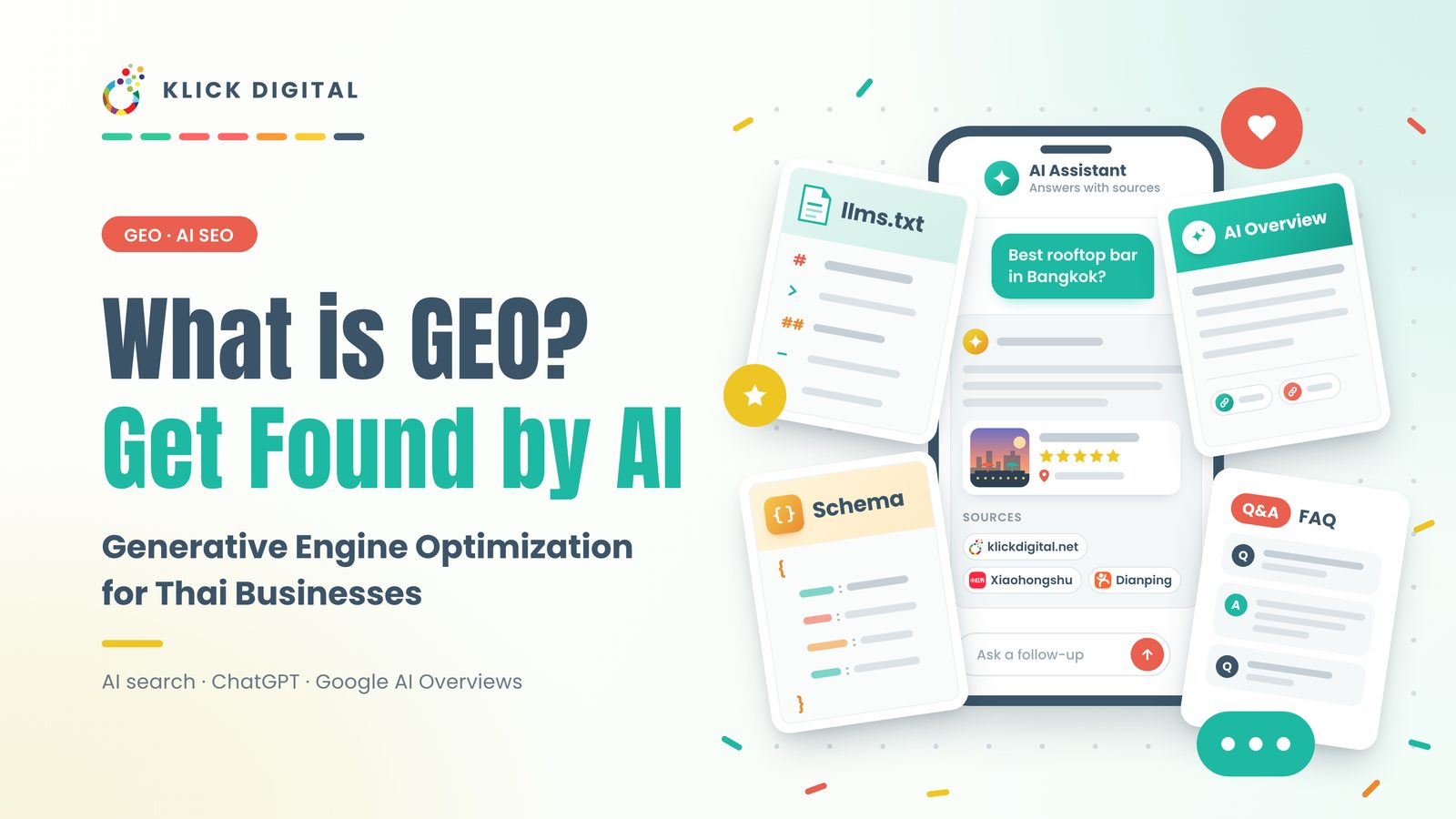
- GEO (Generative Engine Optimization) means making your business easy for AI assistants such as ChatGPT, Google AI Overviews and Perplexity to find, understand and recommend in their answers.
- It builds on good SEO: clear facts, direct answers, consistent business information, reviews and mentions on other trusted websites.
- If you want Chinese customers, remember that Chinese AI assistants mostly read Chinese-language content, so a Chinese-language presence matters as much as your English and Thai website.
What is GEO (Generative Engine Optimization)?
GEO is the practice of shaping your content and online presence so that AI tools mention, quote or link to your business when people ask them questions. Instead of aiming only for a position on a list of blue links, you aim to become one of the sources an AI answer is built from.
The term comes from a 2023 research paper by researchers at Princeton University and partners, later presented at the KDD 2024 conference. Their experiments showed that the way content is written, for example adding clear facts, sources and quotable statements, can change how visible it is inside AI-generated answers.
How is GEO different from SEO and AEO?
SEO helps your pages rank in search results, AEO (Answer Engine Optimization) helps your content become the direct answer to a question, and GEO helps AI assistants choose and cite you when they write a full answer. In practice the three overlap heavily, and good SEO remains the foundation of both AEO and GEO.
| SEO | AEO | GEO / “AI SEO” | |
|---|---|---|---|
| Main goal | Rank on search result pages | Be the direct answer (featured snippets, voice assistants) | Be cited or recommended inside AI-written answers |
| Where it shows | Google, Bing results lists | Answer boxes, voice search | ChatGPT, Google AI Overviews and AI Mode, Perplexity, Chinese AI assistants |
| What matters most | Relevance, links, technical health | Clear question-and-answer content | Clear facts, trusted mentions, consistency across the web |
| How you measure it | Rankings, clicks | Answer box appearances | Brand mentions and citations in AI answers |
You will also hear GEO called “AI SEO” or “SI SEO” or “LLM optimisation”. The names differ, but the idea is the same: help machines understand exactly who you are and why you are a good answer.
How do ChatGPT, Google AI Overviews and Perplexity pick their sources?
Most AI search tools first search the web, then read a small set of relevant pages and write an answer that links back to some of them. Pages that are easy to crawl, clearly written and trusted by other sites have a better chance of being picked.
- ChatGPT search can look up the web and show answers with links to sources. OpenAI uses a crawler called OAI-SearchBot for this, so if you block it in your robots.txt file, your site is less likely to be shown.
- Google AI Overviews and AI Mode draw on Google’s search index. Google explains that these features may run several related searches on subtopics (it calls this “query fan-out”) to find a wider set of helpful pages. Google also says there are no extra requirements to appear: standard SEO good practice and helpful, people-first content are what count.
- Perplexity searches the web in real time and shows numbered citations next to its answer, so readers can check each claim against the original source.
The common thread: AI tools reward content that is accessible, factual, well organised and backed up by other sources.
What should a Thai business do for GEO? A practical checklist
Start with the basics you control, your own website and business listings, then build trust signals from customers and other websites. None of these steps is a trick; each one simply makes your business easier to understand and easier to recommend.
- Put clear facts on your site. State who you are, what you offer, where you are, opening hours, and who you serve, in plain sentences. AI tools cannot recommend what they cannot find.
- Use question-style headings with direct answers. Write headings the way customers ask, such as “Do you offer halal food?”, and answer in the first two or three sentences below.
- Add an FAQ section and structured data. FAQs cover the questions people really ask. Structured data (schema.org markup such as Organization, LocalBusiness or Product) helps search engines read key details, as long as it matches the visible text on the page.
- Consider an llms.txt file. This short Markdown file at yoursite.com/llms.txt summarises your site and links to your key pages. Proposed by Jeremy Howard in 2024, it is a community convention, not an official standard.
- Keep business information consistent everywhere. Use the same name, address, phone number and descriptions on your website, Google Business Profile, social media and listing platforms.
- Collect genuine reviews. Reviews on Google, TripAdvisor and, for Chinese visitors, Dianping give AI tools real-world evidence that customers like you.
- Get mentioned by other websites. Press coverage, partner pages, directories and creator content show that others vouch for you.
- Keep content up to date. Refresh menus, opening hours, service details and seasonal information, and show a visible “last updated” date.
- Do not block the right crawlers. Check that your robots.txt file lets search engines and AI search crawlers read the pages you want recommended.
Is llms.txt worth adding to my website?
It is optional and quick to set up, but it is not a ranking guarantee. Think of it as a helpful table of contents for AI agents, placed alongside your sitemap, not as a replacement for good content.
Support varies between AI tools, so put most of your effort into the checklist above and add llms.txt once those basics are in place.
What does GEO mean for businesses targeting Chinese customers?
Chinese travellers and shoppers mainly use Chinese AI assistants and platforms, and those tools read mostly Chinese-language content. If your business only exists in Thai and English, it may be invisible when a Chinese customer asks an AI for recommendations.
Assistants such as Doubao (from ByteDance), DeepSeek and Tencent’s Yuanbao are widely used in mainland China. Tencent says Yuanbao’s search draws on content from WeChat Official Accounts, and Xiaohongshu has its own AI search assistant built on the notes people share on the platform. So for Chinese customers, GEO means:
- A Chinese-language version of your key information, with your Chinese business name used consistently.
- Fresh Xiaohongshu (小红书) notes from real visitors and creators (KOCs and KOLs).
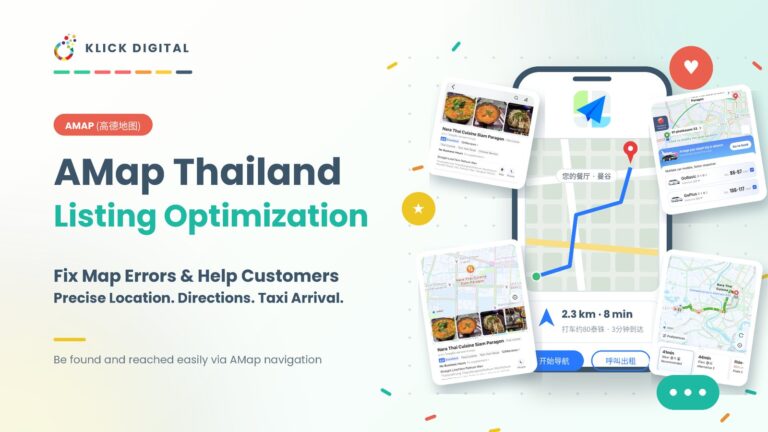
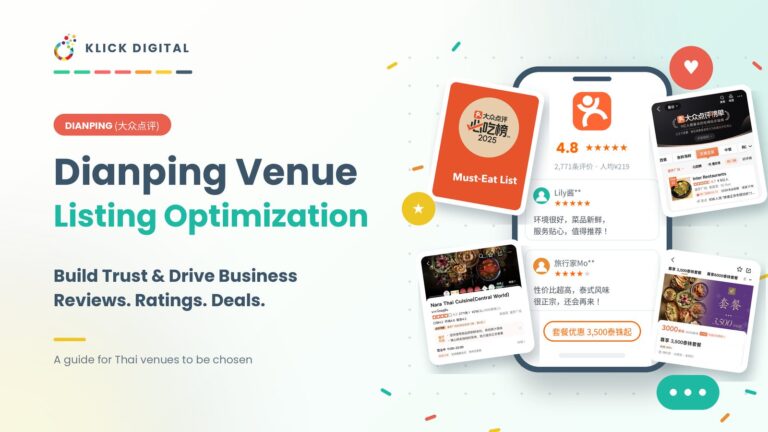
- Complete listings on Dianping (大众点评) and AMap (高德地图) with correct Chinese names, addresses, photos and reviews.
- Chinese press and WeChat content that independent sources can cite.
How can Klick Digital help with GEO for Chinese customers?
Klick Digital has helped Thai businesses reach Chinese audiences since 2016, from offices in Bangkok and Zhuhai, with a team that works in Thai, Chinese and English. We build the Chinese-language presence that both people and AI assistants rely on.
- Official Thailand partner for Weibo, Dianping/Meituan and AMap, so your listings are complete and accurate where Chinese travellers choose and navigate.
- Award-winning Xiaohongshu agency with direct support from Xiaohongshu HQ, including KOC and KOL content that creates fresh, trusted notes.
- Official accounts and content on WeChat, Weibo, Xiaohongshu and Douyin, plus online PR through 500+ online media for third-party mentions.
- Brand strategy and Chinese naming, so your business information stays consistent across every platform.
Frequently asked questions
What does GEO stand for?
GEO stands for Generative Engine Optimization. It means optimising your content and online presence so that generative AI tools, such as ChatGPT, Google AI Overviews and Perplexity, can find, understand and cite your business in their answers.
Is GEO replacing SEO?
No. GEO builds on SEO rather than replacing it. Most AI search tools rely on web search results, so a well-structured, crawlable and trusted website is still the starting point.
What is the difference between AEO and GEO?
AEO focuses on becoming the single direct answer to a question, such as a featured snippet or a voice assistant reply. GEO is broader: it aims to get your business cited or recommended inside longer AI-generated answers across many tools.
Do I need an llms.txt file?
It is not required. llms.txt is an optional, community-proposed file that summarises your site for AI tools. Google says no special AI files are needed for its AI features, so focus first on clear content, structured data and consistent business information.
How do I know if AI tools mention my business?
Ask the tools directly. Try the questions your customers would ask, in English, Thai and Chinese, on ChatGPT, Google, Perplexity and Chinese assistants, and note whether and how your business appears. Repeat regularly, as answers change over time.
Do Chinese AI assistants use my English or Thai website?
They may, but they rely heavily on Chinese-language sources such as Xiaohongshu notes, WeChat articles and local listing platforms. Having accurate Chinese-language content and listings gives them far more to work with.
Read next
Want Chinese customers and AI assistants to find you?
Tell us about your business and we will show you how you currently appear to Chinese customers and what to fix first, from Chinese-language content to Dianping, AMap and Xiaohongshu.
Book a free call or message us on LINE. You can also email info@klickdigital.net or call +66 88 624 1965.