For a decade, the standard advice to any brand entering China was to open a store on Tmall. That advice is now only half the plan.
E-commerce has stopped gaining share. Online sales of physical goods made up 26.1% of China’s retail sales in 2025, according to the National Bureau of Statistics. That is down from a peak of 27.6% in 2023, as China’s Department Stores Report 2025-2026 records. Chinese shoppers still buy online. What has changed is where a new brand earns their attention and trust: in places they can visit, touch, taste and photograph.
For a Thai brand, that changes the entry plan. This guide sets out what the 2026 data shows, why a pop-up store in China is the lowest-risk way to act on it, and how to run one that sells.
What the 2026 data shows
Three findings from the past year point the same way.
Online has stopped taking share
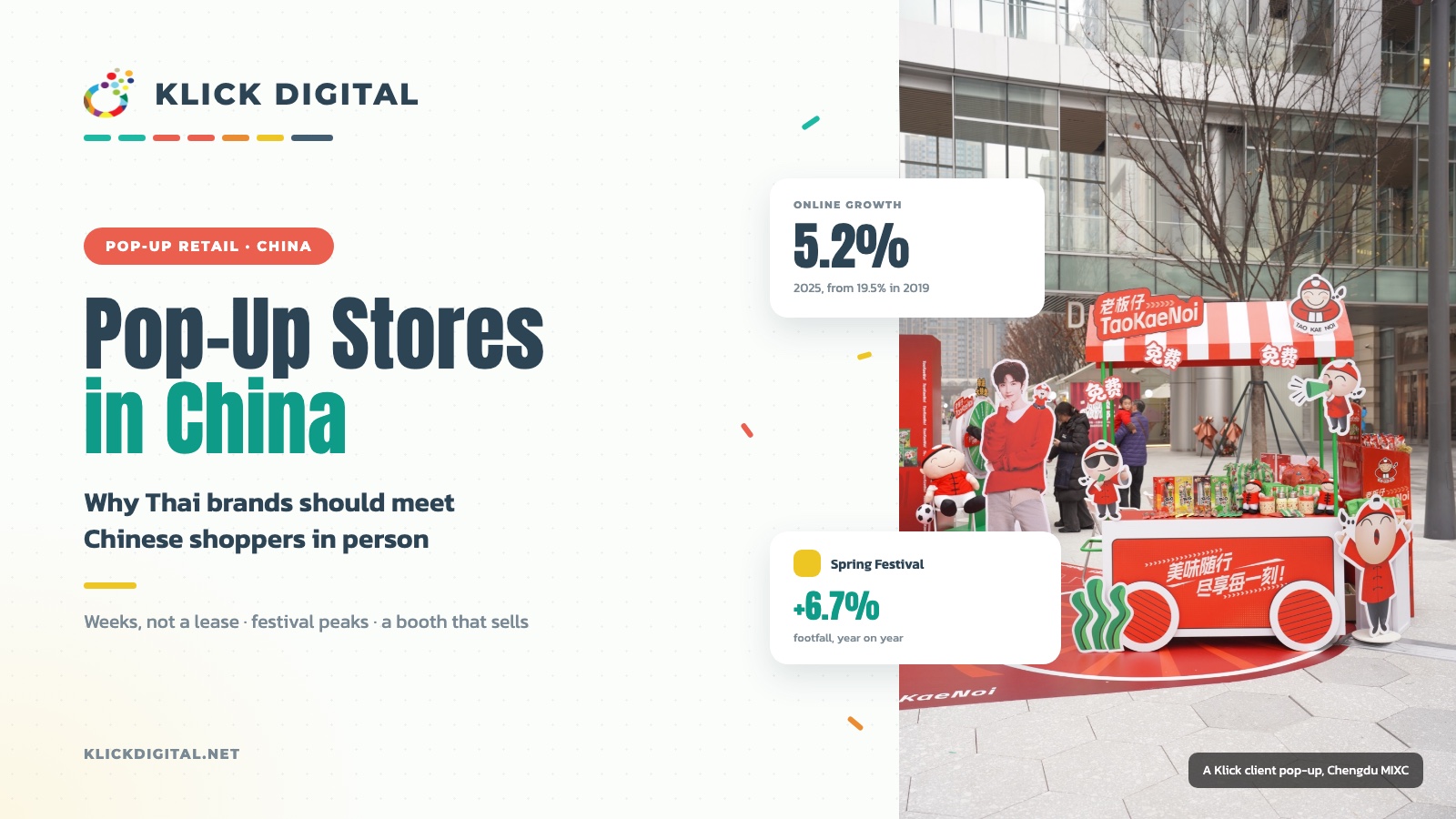
China’s retail sales reached RMB 50.1 trillion in 2025, up 3.7%. Online sales of physical goods grew 5.2%. In 2019 they grew 19.5%. The channel is still very large, but it is no longer where the growth is.
Shoppers go out for experiences, not for shelves
This is not a return to the old department store. In the same industry report, 51.9% of department store operators said footfall fell in 2025, and 38.3% cited a lack of experiential appeal.
The venues that are growing give people a reason to visit. Shanghai’s Bailian ZX Creative Center, a mall built around anime and character goods, hosted nearly 700 events in 2024. Its sales rose 70% and its footfall rose 40%, China Daily reported.
Young shoppers say the same. In a survey of 1,334 young consumers reported by People’s Daily Online in January 2026, 79.1% were optimistic about the future of offline shopping. An even larger share, 84.3%, said interactivity and immersion come first when they shop.
Holidays are when the crowds come
China’s Ministry of Commerce monitors 78 pedestrian streets and business districts. During the 2026 Spring Festival holiday, their footfall rose 6.7% on the year before and their revenue rose 7.5%, Xinhua reported. Over National Day in October, footfall rose again, by 2.5%.
The pattern is consistent. People will travel for an experience, and they travel most at festival time.
Why meeting shoppers in person works for a new brand
A brand that is new to China starts with no reviews, no reputation and no shelf. Meeting shoppers face to face solves three problems at once.
Trial. Chinese consumers are unusually open to trying something foreign. In PwC’s 2025 consumer survey, 23% of Chinese respondents ranked the chance to try new or international foods among their top reasons to switch food brands. The global figure was 16%. A sample in the hand does what a product page cannot.
Trust. Shoppers can see the product, ask a question and judge the people behind it. The physical store also carries more weight in China than elsewhere. In the same survey, 42% of mainland Chinese respondents said store displays are where they learn about a company’s climate and sustainability efforts, against 25% globally.
Content. Every visitor who photographs your booth can become a review on Xiaohongshu, where the next shopper will search before buying. PwC’s advice to retailers is to make the store “a place of discovery and entertainment”. A pop-up is that idea in its simplest form.
Why a pop-up, not a permanent store
Brands that can afford it are investing heavily in physical presence. Shanghai alone counted 1,093 first stores in 2025 and 8,472 since 2018, according to the Shanghai government. JLL counted nearly 90 large-format flagship stores opened in China’s major cities between mid-2024 and mid-2026, averaging more than 1,200 square metres each.
A brand entering the market cannot sign a flagship lease, and should not. A pop-up buys the same face time without the commitment. It is already a mainstream format. China’s pop-up market was estimated at about RMB 400 billion in 2023, and 44% of pop-ups are built mainly to sell, Xinmin Weekly reported.
| Pop-up | Permanent store | |
|---|---|---|
| Commitment | Weeks | A lease of several years |
| Upfront cost | A booth fee | Fit-out, deposit, staff and stock |
| Time to open | Weeks | Months |
| What you learn | Which products, prices and messages work, before you commit | Whether your first guess was right |
| Best for | Testing a market, launching a product, festival peaks | Demand you have already proven |
Thai retailers are already using the format. In July 2025 The Mall Group took its Kud-Thai Holiday market to the Sunland Incity mall in Shanghai with its Chinese partner SCPG. The plan was to reach more than 200 SCPG malls in 55 cities, the International Association of Department Stores reported.
How to run a pop-up store in China that sells
Seven rules separate a booth that sells from one that only shows.
- Go when the crowd is there. Book festival weeks. Footfall peaks around New Year and Chinese New Year, and shoppers arrive ready to buy gifts.
- Let people try. Offer a taste, a tester or a demonstration. Trial is the one thing a pop-up does better than any online channel.
- Design for the photo. Give visitors one striking thing to photograph, with your brand name readable in the frame.
- Speak Mandarin and take mobile payment. Put a Mandarin speaker who knows the brand story at the booth. Price in RMB and accept Alipay and WeChat Pay.
- Give shoppers a way to buy again. Show a QR code that leads to your online store or your distributor. A pop-up with no next step sells once.
- Clear your products first. Food and cosmetics need Chinese labels and the right registrations before they can be sold in a mall. Start early.
- Measure every week. Track units sold, samples given, followers gained, Xiaohongshu posts and trade enquiries. Change what is not working while the booth is still open.
Why this matters now
Chinese arrivals to Thailand are still up 12.4% for the year to October. But October itself fell 13.6%, and the Association of Thai Travel Agents has warned that November and December could run about 20% below last year, The Nation reported. If fewer Chinese shoppers reach your counter this winter, that is the case for going to theirs.
Frequently asked questions
Is offline retail really recovering in China?
Not everywhere. E-commerce’s share of retail sales slipped from 27.6% in 2023 to 26.1% in 2025, yet about half of department stores still lost footfall. Growth is concentrated in venues and events that offer an experience. For everyday packaged goods, e-commerce is still gaining and reached 38% of urban spending in 2025, according to Bain & Company and Worldpanel.
What should the budget for a pop-up store in China cover?
The total depends on the city, the mall and the length of stay. The booth fee is the main cost, so check what it covers: some fees buy the space alone, while others include the booth, set-up, daily operations and promotion. Either way, allow for staff and for shipping your stock to China.
What does a pop-up organiser handle, and what do I handle?
It depends on what you buy, so get the split in writing before you book. In a full-service package, the organiser handles the booth, set-up, warehouse receiving and mall paperwork, and you prepare the products and the artwork and ship the stock. In a space-only deal, most of that work is yours. Either way, your products must meet China’s import rules for their category, so check them before you ship.
Which products work best at a pop-up?
Products people can taste, smell, test or hold: snacks and drinks, beauty and wellness, spa and aromatherapy, fashion accessories and crafts. If a shopper can understand it in ten seconds at the booth, it suits the format.
The short version
The ordinary store is not coming back in China. The experience is. A pop-up lets a Thai brand offer one for a few weeks, learn what sells, and decide its next step on evidence.
To check China’s import rules for your product category, book a call with Klick Digital, message us on LINE, email info@klickdigital.net or call +66 88 624 1965.
Sources
- National Bureau of Statistics of China, “Total Retail Sales of Consumer Goods in December 2025”, 20 January 2026
- China Commerce Association for General Merchandise and HKUST Li & Fung Supply Chain Institute, “China’s Department Stores Report 2025-2026”, April 2026
- China Daily, “Real-world retail beckons China’s youth”, 1 January 2026
- People’s Daily Online, “Chinese young people optimistic about growth of offline shopping”, 20 January 2026
- Xinhua, Spring Festival holiday consumption report (in Chinese), 24 February 2026
- Xinhua, “Holiday travel, spending boom mirror vitality of China’s vast market”, 9 October 2026
- PwC, “The New Chinese Consumer: Food, Health, Sustainability”, December 2025
- Shanghai International Services Portal, “Shanghai’s first-store economy blooms”, 8 April 2026
- JLL, “Large-format flagships redefine retail in China”, 11 August 2026
- Xinmin Weekly, feature on pop-up stores (in Chinese), 17 February 2025
- International Association of Department Stores, “The Mall showcases Thai products at Shanghai event”, July 2025
- The Nation, “Chinese arrivals to Thailand could fall 20% in final two months of 2026”, 6 November 2026
- Bain & Company and Worldpanel, “China Shopper Report 2026, Vol. 1”, 16 June 2026