By the Klick Digital team · Updated October 2026
In short
- Chinese travellers increasingly ask AI assistants such as Doubao, DeepSeek, Tencent Yuanbao and Alibaba’s Qwen, plus AI search inside apps like Xiaohongshu, to plan trips and suggest places to eat, stay and visit.
- These tools rely mainly on Chinese-language content: Xiaohongshu notes, Dianping reviews, WeChat articles and map data. If your venue is missing there, AI is unlikely to recommend it.
- The fix is practical: complete Chinese listings on Dianping and AMap, fresh Xiaohongshu notes and reviews, and one consistent Chinese name and address everywhere.
Do Chinese travellers really use AI to plan trips to Thailand?
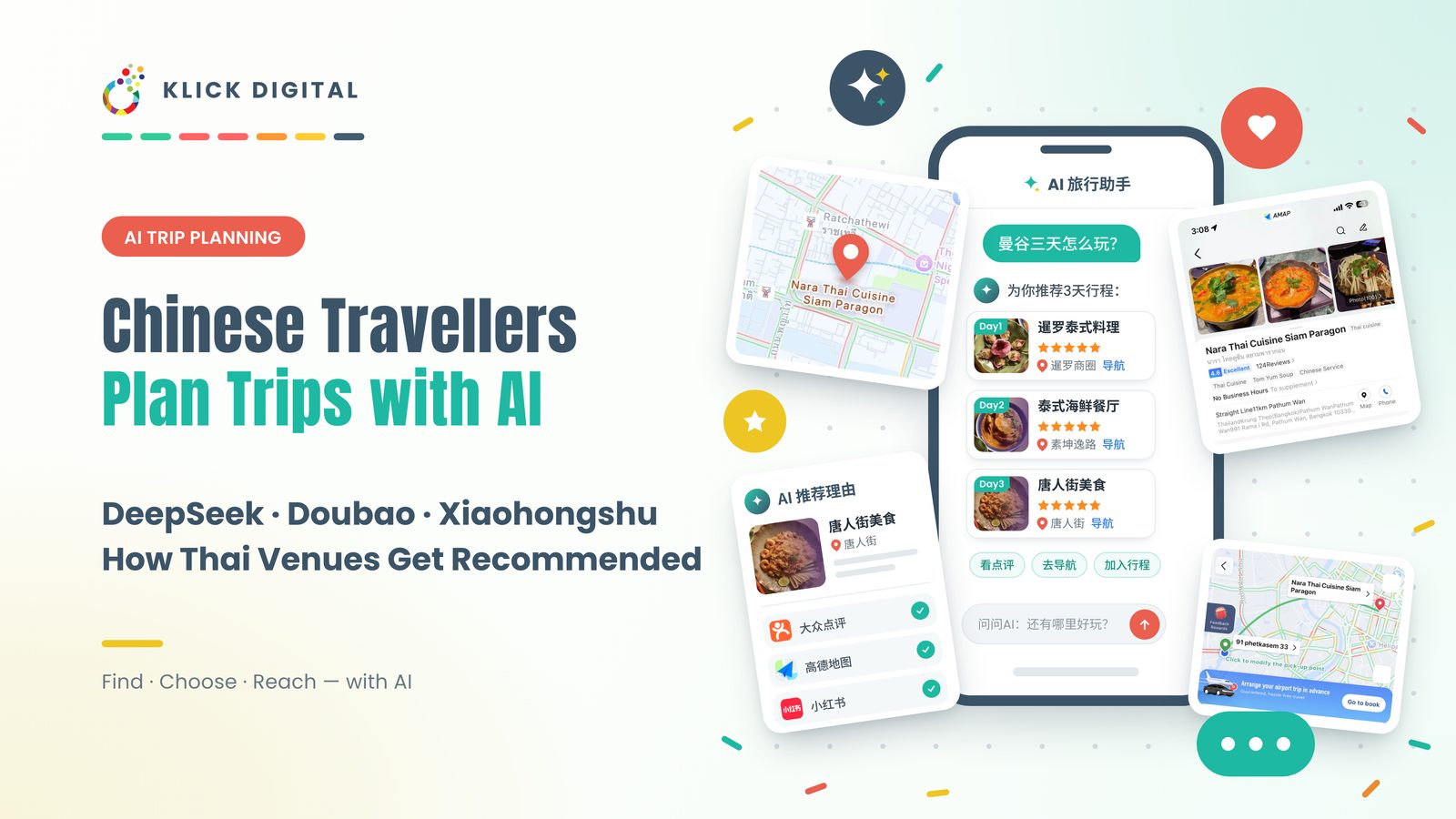
Yes. AI assistants have become everyday tools in China, and trip planning is a natural use: travellers ask for itineraries, restaurant ideas and hotel suggestions in a single conversation. The answers they get shape which venues make the shortlist.
Travel planning in China was already search-led, with Xiaohongshu used as a lifestyle search engine and Dianping for reviews. AI assistants now sit on top of that behaviour, summarising what people have written and turning it into ready-made plans. For a Thai venue, the question is no longer only “Can travellers find us?” but also “Will an AI recommend us?”
Which Chinese AI assistants do travellers use?
The best-known general assistants are Doubao, DeepSeek, Tencent Yuanbao, Baidu’s Ernie and Alibaba’s Qwen, alongside AI features built into travel and lifestyle apps. Western tools such as ChatGPT and Google are not generally available in mainland China, so Chinese travellers depend on these local tools.
| Assistant or feature | Company | How travellers might use it | Where it tends to draw information from |
|---|---|---|---|
| Doubao (豆包) | ByteDance | Everyday questions, trip ideas, AI search | Web search across Chinese-language content |
| DeepSeek | DeepSeek | General questions and planning | Model knowledge plus web search when enabled |
| Yuanbao (元宝) | Tencent | Planning and search, available inside WeChat | Web search plus WeChat Official Accounts content |
| Ernie / Wenxiaoyan (文心 / 文小言) | Baidu | AI search by text, voice or image | Baidu search and Chinese web content |
| Qwen (千问) | Alibaba | Itineraries and bookings via Fliggy, maps via AMap | Alibaba services such as Fliggy and AMap |
| Diandian (点点) | Xiaohongshu | Conversational search for lifestyle and travel tips | Xiaohongshu notes |
| Xiaomei (小美) | Meituan | Restaurant recommendations and bookings | Meituan and local-services data |
| TripGenie | Trip.com | Itineraries and travel bookings | Trip.com travel data |
| AMap AI agent | Alibaba’s AMap | Trip planning and place recommendations | Map and point-of-interest (POI) data |
A few details worth knowing:
- Doubao, launched by ByteDance in 2023, has become one of China’s most widely used AI chatbots.
- DeepSeek drew global attention in January 2025 when its app briefly topped app store charts, including in the United States.
- Yuanbao is built on Tencent’s Hunyuan model and has also integrated DeepSeek. Tencent has said its search draws on public content from WeChat Official Accounts.
- Qwen was linked to Alibaba services including Fliggy and AMap in early 2026, so it can help design itineraries and complete travel bookings.
- Diandian is Xiaohongshu’s AI search assistant, built around the notes users share on the platform.
Features change quickly, so treat this as a snapshot rather than a complete list.
Where do these AI assistants get their recommendations?
They mostly draw on Chinese-language sources: user notes on Xiaohongshu, reviews and ratings on Dianping and Meituan, articles on WeChat, and place data from maps such as AMap. When a venue has little or no Chinese-language content, the AI has almost nothing to work with.
This is the key difference from Western AI search. A Thai restaurant may rank well on Google and have excellent TripAdvisor reviews, yet still be invisible to a traveller asking Doubao or Yuanbao for “the best seafood near Patong” in Chinese. Each assistant tends to favour content from its own ecosystem: Xiaohongshu notes for Diandian, WeChat for Yuanbao, Alibaba services for Qwen.
How does AI fit the Find → Choose → Reach journey?
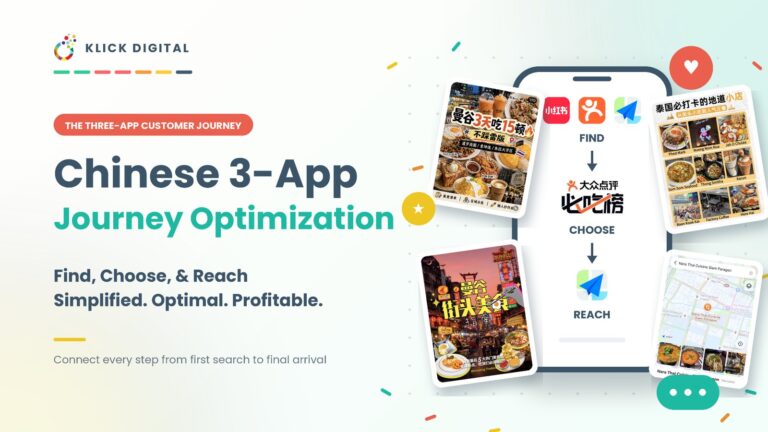
AI does not replace the Chinese traveller journey; it speeds it up. Travellers still find ideas on Xiaohongshu, choose on Dianping/Meituan and reach the venue with AMap, and AI assistants increasingly summarise all three steps in one answer.
- Find (Xiaohongshu): notes and videos from real visitors inspire the trip. AI search reads those notes to suggest places.
- Choose (Dianping/Meituan): reviews, ratings, deals and the Must-Eat list (必吃榜) help travellers decide. AI tools use these signals when ranking options.
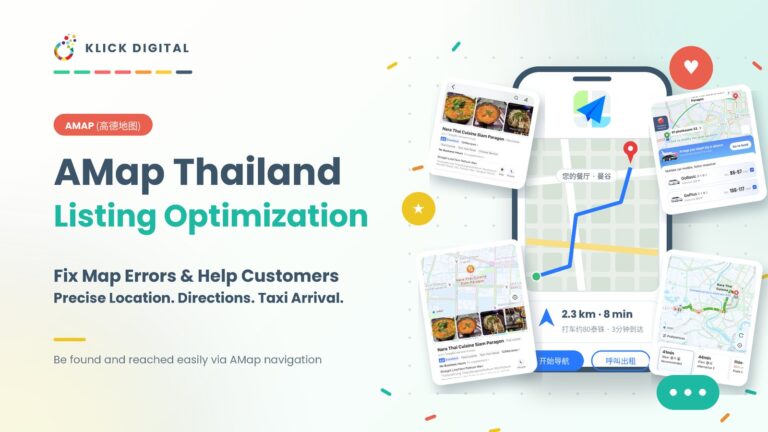
- Reach (AMap): accurate map listings let travellers get directions or call a taxi to the door. If your pin, Chinese name or address is wrong, even a strong recommendation can end in a lost customer.
How can your Thai venue get recommended by Chinese AI assistants?
Make sure accurate, rich and recent Chinese-language information about your venue exists on the platforms these assistants read. There is no single switch to flip; recommendations follow the quality and consistency of what is already published about you.
Checklist for Thai venues:
- Complete your Dianping listing with a Chinese name, full address, opening hours, photos, menu highlights and deals.
- Claim and correct your AMap listing so the pin, Chinese name, phone number and address are right.
- Publish fresh Xiaohongshu notes regularly, including your own account and content from real visitors.
- Encourage genuine reviews from Chinese guests on Dianping and Xiaohongshu, and reply to them.
- Use one consistent Chinese name and address across Dianping, AMap, Xiaohongshu, WeChat and your website.
- Offer Chinese-language menus and key information, such as signature dishes, room types, facilities and how to get there.
- Work with KOCs and KOLs so that trusted, searchable content about you keeps appearing.
- Check your visibility by asking the assistants in Chinese the questions your guests would ask, and note what comes back.
What mistakes stop venues from being recommended?
The most common problems are missing or incomplete Chinese listings, different Chinese names on different platforms, outdated information and too few recent reviews. Each one makes it harder for AI tools to connect the dots and trust your venue.
- Only English and Thai content, with nothing in Chinese.
- Several Chinese names or spellings, so the AI cannot tell they are the same place.
- Wrong map pins or old opening hours.
- A burst of content once, then silence for months.
How does Klick Digital help Thai venues get recommended?
Klick Digital helps Thai venues build the Chinese-language presence that travellers and AI assistants rely on, across the full Find → Choose → Reach journey. Our team in Bangkok and Zhuhai works in Thai, Chinese and English.
- Official Thailand partner for Weibo, Dianping/Meituan and AMap: we set up and optimise your listings where Chinese travellers choose and navigate.
- Award-winning Xiaohongshu agency with direct support from Xiaohongshu HQ, including KOC and KOL content from nano to mega creators.
- Chinese content and official accounts on Xiaohongshu, WeChat, Weibo and Douyin.
- Online PR through Chinese online media for trusted third-party mentions.
Frequently asked questions
Which AI apps do Chinese tourists use to plan trips?
Popular options include ByteDance’s Doubao, DeepSeek, Tencent’s Yuanbao, Baidu’s Ernie (Wenxiaoyan) and Alibaba’s Qwen. Many also use AI features inside Xiaohongshu, Meituan and Trip.com, which draw on each platform’s own content.
Can Chinese travellers use ChatGPT or Google in China?
These services are not generally available in mainland China, so most travellers rely on Chinese AI assistants and apps when planning. Once in Thailand some may use other tools, but their plans are often made before they leave.
Does my English or Thai website help with Chinese AI recommendations?
It can help a little, but Chinese assistants rely mostly on Chinese-language content. Accurate Chinese listings on Dianping and AMap and fresh Xiaohongshu notes usually matter far more.
What is the most important first step for a Thai venue?
Get your Chinese name, address and core information right and consistent on Dianping and AMap, then build regular Xiaohongshu content and genuine reviews on top of that foundation.
Can I pay to be recommended by Chinese AI assistants?
AI answers are generated from the content the assistants can find and trust, so the reliable route is improving your Chinese-language listings, notes and reviews. Paid campaigns on the platforms themselves can speed up that content, but they do not directly control AI answers.
How long does it take to appear in AI recommendations?
It varies with your starting point, category and location. Listing fixes can take effect quickly, while trust from notes and reviews builds over months of consistent activity.
Read next
Want Chinese travellers’ AI to recommend your venue?
Tell us about your venue and we will check how it appears on Dianping, AMap and Xiaohongshu, and what to fix first so Chinese travellers, and their AI assistants, can find and choose you.
Book a free call or message us on LINE. You can also email info@klickdigital.net or call +66 88 624 1965.