By the Klick Digital team · Updated October 2026
In short
- Choose a Chinese marketing agency by asking for proof: which platforms it is officially partnered with, who on the team is a native Chinese speaker, and live work on the platforms your customers use, such as Xiaohongshu (小红书), Dianping/Meituan (大众点评/美团) and AMap (高德地图).
- Make sure your accounts, content and data are registered in your company’s name, and that reports link activity to visits, bookings, orders or enquiries.
- Check the contract and exit terms, ask for case examples you can verify and, if you plan to sell into China, confirm the agency has a team in China.
Choosing a Chinese marketing agency in Thailand is harder than choosing a normal digital agency, because you often cannot read the work yourself. The platforms are in Chinese, the results are reported in Chinese apps, and many claims are difficult to check. These 10 questions will help you separate agencies that can genuinely deliver from those that simply say they can.
Why is choosing a Chinese marketing agency so difficult?
Most Thai business owners cannot easily judge Chinese-language content, Chinese platform dashboards or Chinese influencers. That creates an information gap, and the only way to close it is to ask specific questions and ask for proof.
Common problems Thai businesses run into include:
- Agencies describing themselves as “official partners” of platforms without being able to prove it
- Content that is machine-translated and reads badly to Chinese users
- Accounts registered in the agency’s name, so the business loses them when the contract ends
- Reports full of numbers that are hard to connect to real customers
1. Are you an official partner of any Chinese platform, and can you show proof?
Ask exactly which platforms the agency is officially partnered with, and ask to see evidence. “We work with Xiaohongshu” is not the same as “we are an official partner”, and a genuine partner should be happy to explain what the partnership covers.
What to look for:
- A clear list of platforms where the partnership is official
- Honest distinctions between official partnerships, awards and informal relationships
- Evidence such as partner certificates, platform listings or direct contacts they can describe
Be cautious if an agency claims official status on every platform.
2. Is your team native Chinese, and who will actually work on my account?
Chinese consumers notice immediately when content is not written by a native speaker. Ask how many native Chinese speakers are on the team, and which of them will write your content, manage your accounts and speak to influencers. Also ask who your day-to-day contact will be.
3. Which platforms do you actually run every day?
Many agencies list every Chinese app on their website. Ask which platforms they manage accounts on right now, and ask to see live examples.
For marketing to Chinese tourists in Thailand, the important platforms usually include:
- Xiaohongshu (小红书, RedNote), where travellers discover places
- Dianping/Meituan (大众点评/美团), where they check reviews, ratings and deals before choosing
- AMap (高德地图), which they use for directions and taxis
For selling into China, ask about Tmall (天猫), Taobao (淘宝), JD (京东), Xiaohongshu (小红书), Douyin (抖音), WeChat (微信), Weibo (微博) and Kuaishou (快手), depending on your category.
4. Can you create Chinese-language content in-house?
Ask whether the agency writes and produces Chinese content itself or outsources it. Request samples of posts, short videos and campaign materials created for other clients.
Good signs:
- Content that reads naturally and matches the style of each platform
- In-house video capability, from short video to larger productions
- A clear approval process, so you can review content (with a translation) before it goes live
5. How do you work with KOLs and KOCs?
Influencer work is central to Chinese marketing, but quality varies widely. Ask how the agency finds and vets KOLs (key opinion leaders) and KOCs (everyday reviewers), what sizes of influencer they work with, and how they check that audiences are real and relevant.
Ask to see previous influencer posts they arranged, and whether you approve the list before anyone is booked.
6. What will your reports show, and how often?
A useful report connects activity to business outcomes. Ask for a sample report before you sign.
A good Chinese marketing report should:
- Arrive on a regular schedule, typically monthly
- Be written in a language your team understands
- Show what was done, what happened and what will change next month
- Link platform numbers to real outcomes you care about, such as visits, bookings, orders or enquiries
7. Who owns the accounts, content and data?
This is one of the most important questions and one of the most often forgotten. Ask whether your official accounts will be registered in your company’s name, who holds the login details, and who owns the content and customer data produced.
Get the answer in writing. If you ever change agency, you should keep your accounts, followers, reviews and content.
8. What are the contract and exit terms?
Read the contract carefully before signing. Ask:
- What is the minimum contract length?
- What notice period do you need to end the contract?
- What happens to accounts, content and ongoing campaigns if we stop working together?
- Exactly what is included in the scope, and what counts as extra work?
A confident agency will explain these terms clearly and will not rush you to sign.
9. Can you show case examples I can verify?
Ask for examples from businesses similar to yours, and ask for details you can check yourself: live accounts, published posts, public listings or awards with the organiser named.
Be careful with case studies that show impressive numbers you cannot verify.
10. Do you have a presence in China?
If you want to sell into China, or need close relationships with Chinese platforms and influencers, a team on the ground in China is a real advantage. Ask where the agency’s offices are, what the China-side team does, and how they coordinate with the Thailand team.
What do good and bad answers look like?
Use this table in your agency meetings to compare answers side by side. A good answer is specific and backed by something you can check; a red flag is vague, unverifiable or leaves you without control.
| Question | Good answer | Red flag |
|---|---|---|
| Official platform partnerships | Names specific platforms and shows proof | Claims official status on every platform, with no evidence |
| Native Chinese team | Names who will write your content and manage your accounts | Cannot say who will work on your account |
| Platforms run every day | Shows live accounts on the platforms you need | Lists every Chinese app but shows no live work |
| Chinese content | Produced in-house, with samples and an approval step that includes a translation | Machine-translated or outsourced, with no review by you |
| KOLs and KOCs | A transparent shortlist that you approve, with audiences checked | Follower counts only; creators booked without your approval |
| Reporting | A sample monthly report linking activity to visits, bookings, orders or enquiries | Pages of numbers with no link to real customers |
| Account ownership | Accounts registered in your company’s name, confirmed in writing | Accounts held in the agency’s name |
| Contract and exit | Clear minimum term, notice period and handover | Vague scope and pressure to sign quickly |
| Case examples | Live accounts, published posts and awards with the organiser named | Impressive numbers you cannot verify |
| Presence in China | Explains what the China-side team does and how it works with Thailand | No clear answer, even though your plans need China |
Quick checklist before you sign
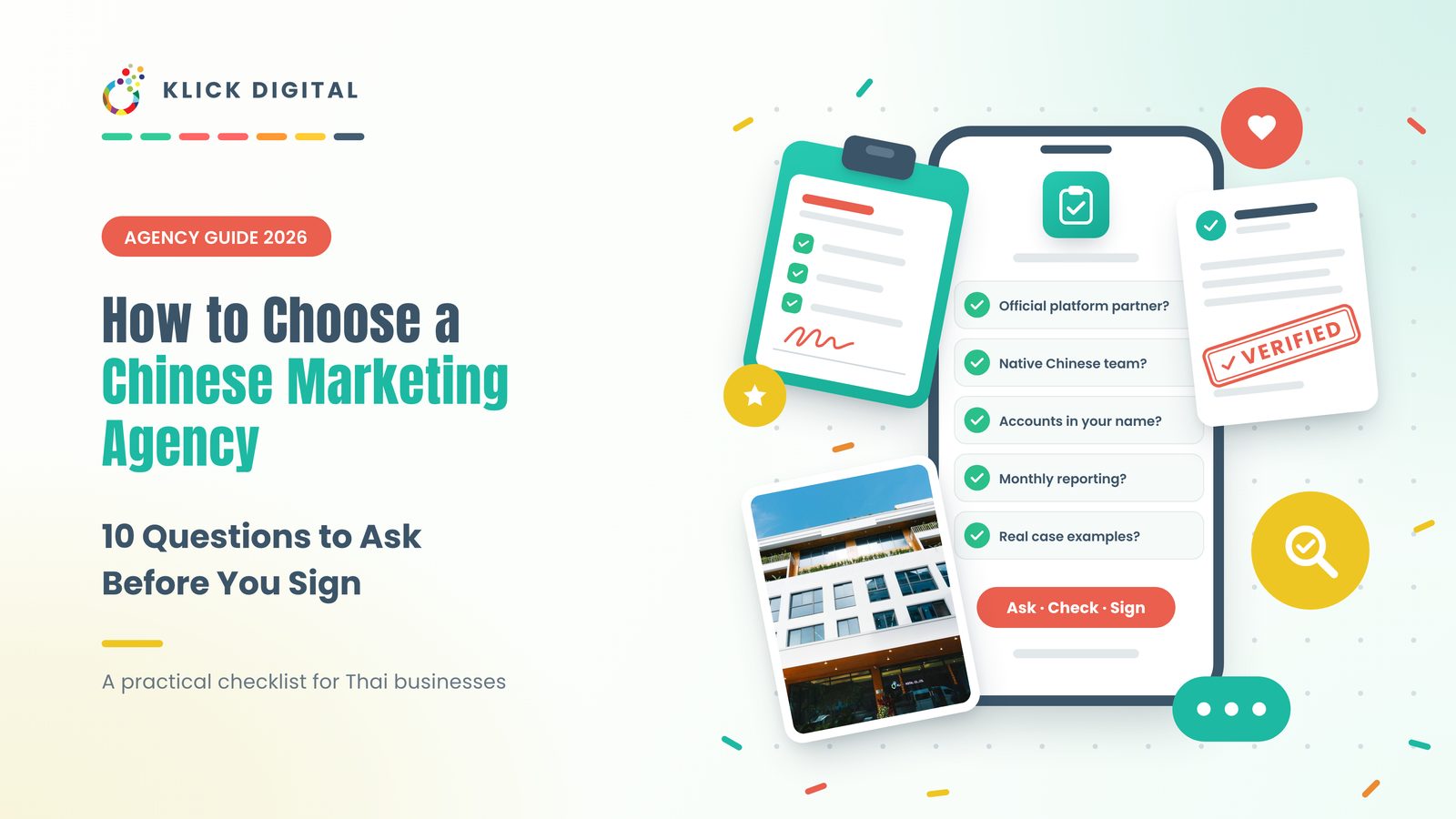
Before you choose a Chinese marketing agency, make sure you can tick every box:
- Official platform partnerships are named clearly and backed by proof
- A native Chinese team will work on your account
- The agency runs live accounts on the platforms that matter to you
- Chinese content is produced in-house, with an approval process
- KOL and KOC selection is transparent and approved by you
- You have seen a sample report and understand it
- Accounts and content will be registered in, and owned by, your business
- Contract length, notice period and exit terms are clear
- Case examples can be verified
- The agency has people in China if your plans need it
How does Klick Digital answer these questions?
We believe any agency should be able to answer these questions openly, including us. Here is how Klick Digital answers them.
- Official partnerships: Klick Digital is the official Thailand partner for Weibo, Dianping/Meituan and AMap. On Xiaohongshu we are an award-winning agency with direct support from Xiaohongshu HQ. On Douyin we have direct communication channels with the platform team.
- Verifiable award: our Xiaohongshu campaign with Big C won “Best Use of Social Media” at the PR Awards Asia-Pacific 2026.
- Team and languages: our team works in Thai, Chinese and English.
- Presence in China: we have offices in Bangkok and Zhuhai, and have been doing Chinese marketing since 2016.
- Clients: we have worked with brands including Big C, Unilever, China Airlines, OPPO, PUMA, Srichand, TaoKaeNoi, Bangkok Hospital Phuket, Baba Beach Club Hua Hin, Thailand Privilege Card and Sunsilk.
- Getting started: a free call, then an audit, a plan, launch and monthly reporting.
Frequently asked questions
What should I ask a Chinese marketing agency first?
Start by asking which Chinese platforms they are officially partnered with and asking for proof. Then ask who on their team is a native Chinese speaker and who will work on your account.
How can I check if an agency is really an official platform partner?
Ask for evidence such as partner certificates or listings and ask them to explain what the partnership includes. Genuine partners are specific about which platforms they are official partners of.
Should my Chinese social media accounts be in my company’s name?
Yes. Ask for accounts to be registered in your company’s name and get this in writing, so you keep your accounts, followers and reviews if you change agency.
Which platforms matter most for Chinese tourists in Thailand?
Xiaohongshu for discovery, Dianping/Meituan for reviews and choosing, and AMap for directions and taxis. Together they cover the main steps from finding a place to arriving at it.
Do I need an agency with an office in China?
It depends on your goals. For attracting Chinese travellers in Thailand, a strong Thailand-based team may be enough. For selling into China, a China-side team is a clear advantage.
Read next
- Chinese marketing agency in Thailand: services and how we work
- Xiaohongshu (RedNote) marketing agency in Thailand
- Chinese KOL and influencer marketing in Thailand
- Xiaohongshu (RedNote) for Thai businesses: a practical guide
Talk to a Chinese marketing agency that welcomes these questions
Bring this list to your next agency meeting, including one with us. We are happy to walk you through each answer and show you the evidence.
Book a free call or add us on LINE. You can also email info@klickdigital.net or call +66 88 624 1965.